Key Takeaways
- When comparing cars as a first-time buyer, we recommend an EV if you have convenient charging access, a realistic ownership budget, and driving habits that suit regular charging.
- EVs can be straightforward for first-time car owners thanks to their smooth power delivery, automatic operation, and generally quiet driving experience.
- Singapore has around 30,500 EV charging points as of March 2026, but we would still check the chargers near your home and workplace rather than relying on the national figure alone.
- A first-time EV buyer should compare the total cost of ownership, including purchase price, insurance, road tax, charging, financing, and expected depreciation.
- If you are still comparing EVs with petrol or hybrid models, an experienced car dealer can help you assess the options against how you actually expect to use your first car.
Introduction
If you are looking for an EV car as your first car in Singapore, we recommend starting your comparison with the BYD Dolphin. Its compact size, easy manoeuvrability, practical everyday range, and relatively accessible positioning make it a sensible option for many new drivers, although suitability will still depend on factors such as budget, COE, insurance, charging access, and current availability.
Among the cars to get for your first car in Singapore, compact EVs are increasingly worth considering if you have reliable charging access and a realistic ownership budget.
That said, the right EV still depends on more than the model itself. A first-time EV buyer should also consider charging access, insurance, road tax, purchase price, expected depreciation, driving frequency, and how easily charging fits into daily life.
What EVs Would We Look at for a First Car?
A compact hatchback such as the BYD Dolphin could appeal to someone who mainly drives around Singapore and values manoeuvrability. The MG4 Electric offers another compact format for buyers comparing practical everyday beginner EVs in Singapore.
Drivers who want more cabin and cargo space might look towards compact SUVs such as the BYD Atto 3 or Hyundai Kona Electric, while someone prioritising technology and greater performance may consider a Tesla Model 3.
Specifications, pricing, insurance costs, and vehicle availability change, so we always compare currently available cars rather than choosing based on reputation alone.
You can explore available vehicles when you are ready to buy a new car and compare them with your other options.
Why We Think EVs Are Worth Considering as a First Car
One of the strongest arguments for an EV is how straightforward it can feel from behind the wheel.
Most EVs deliver power smoothly without conventional gear changes. In urban traffic, that can make acceleration predictable and stop-start driving relatively simple. Many models also provide regenerative braking, although the strength and feel vary from one car to another.
For a new driver, we also see value in the technology commonly included in newer EVs.
Depending on the model and specification, this can include parking cameras, parking sensors, blind-spot monitoring, and other driver-assistance functions.
These features should never replace attentive driving, but they may make an unfamiliar car easier to manage while you build experience.
Charging Access Would Be Our First Check
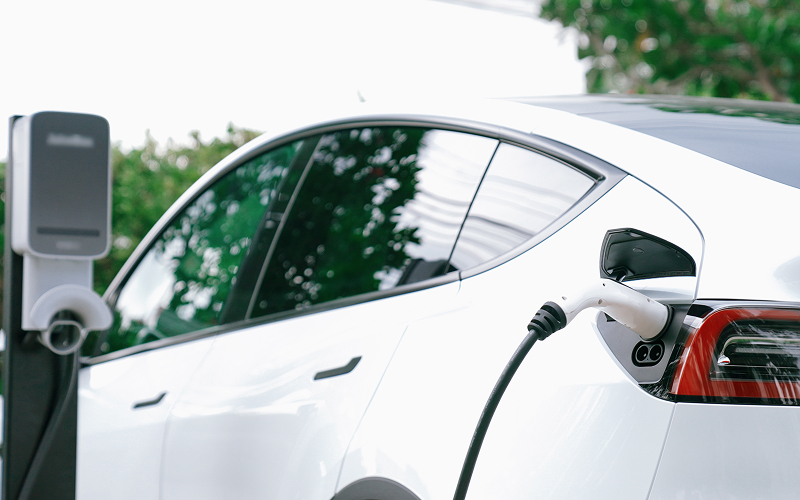
Before recommending any EV car models as your first car, establish where you’ll actually charge it.
Singapore’s charging network has expanded significantly. According to the Ministry of Transport, approximately 30,500 EV charging points had been deployed by March 2026, towards a national target of 60,000 by 2030. More than 90% of HDB carparks were already equipped with charging points by the end of 2025.
That progress makes EV ownership considerably more practical, but the islandwide number does not tell us whether charging will be convenient for you.
Check:
- whether your usual HDB or condominium carpark has chargers;
- how many charging bays are realistically available;
- whether you can charge near your workplace;
- whether you would need to depend on public fast charging; and
- how comfortably charging fits into your weekly routine.
If charging means regularly making a separate journey and waiting for the car, think carefully before recommending an EV as your first vehicle.
Do EVs Really Cost Less to Run?
Potentially, but avoid reducing the comparison to petrol versus electricity.
An EV has no engine oil to replace and generally has fewer conventional drivetrain components requiring routine servicing. Electricity can also cost less per kilometre than petrol, depending on where and how you charge.
However, those savings must be considered alongside the total cost of ownership.
For any EV buyer, we advise you to compare:
Purchase price + financing + insurance + road tax + charging + maintenance + expected depreciation
That calculation is particularly important in Singapore, where COE and vehicle registration costs make the purchase decision much larger than the difference between electricity and petrol expenditure.
We therefore hesitate to describe an EV as an affordable electric car in Singapore based purely on its advertised selling price or monthly instalment.
What About Singapore’s EV Incentives?
Incentives for newly registered EVs remain in 2026, but the figures have changed from earlier years.
Under the EV Early Adoption Incentive (EEAI), fully electric cars registered from 1 January to 31 December 2026 receive a rebate equivalent to 45% of the Additional Registration Fee, capped at S$7,500. The EEAI is scheduled to end after 31 December 2026.
The Vehicular Emissions Scheme also provides a S$22,500 Band A rebate in 2026 for qualifying cars. LTA states that the revised EEAI and VES can provide combined savings of up to S$30,000 off the ARF for eligible electric cars registered in 2026.
Those incentives are part of the purchase calculation, not a reason in themselves to buy an EV.
Should You Consider a Used EV?
If you are looking to buy a second-hand car, a used EV may give you access to a newer-feeling vehicle at a different price point than buying new.
However, pay particular attention to battery condition, remaining battery warranty, servicing history, accident history, charging performance, and the remaining COE period.
The battery is one of the most expensive components in an EV, so its condition deserves considerably more attention than simply checking the displayed range during a short test drive.
Common Mistakes We Would Tell First-Time EV Buyersto Avoid
One of the biggest mistakes is buying according to the maximum advertised driving range. Singapore journeys are relatively short for many motorists, so extra range isn’t necessarily worth stretching your budget for.
Avoid:
- assuming public charging will always be immediately available;
- comparing cars using monthly instalments alone;
- overlooking insurance quotations before purchasing;
- assuming EVs require no maintenance;
- paying substantially more for features you are unlikely to use; and
- buying more performance than a new driver realistically needs.
For a first vehicle, we generally place ease of ownership ahead of specifications that look impressive on paper.
So, Would We Recommend an EV?
Yes, in the right circumstances.
When considering your first car, we think an EV deserves serious consideration if you have convenient charging, expect to drive regularly, and have compared its full ownership cost with equivalent petrol and hybrid cars.
Be more cautious if charging near your home is difficult or if buying the EV requires stretching your budget considerably further than an alternative vehicle.
Your first car should make everyday life easier. The powertrain matters, but it shouldn’t be the only factor.
At M Motors, we help first-time buyers compare cars based on budget, daily driving needs, ownership costs, and practical considerations, rather than directing them to a single category. If you are deciding whether an EV is right for your first car, contact us to discuss the options available and find a vehicle that fits how you plan to drive.