Key Takeaways
- Owning a private hire vehicle gives you control over vehicle choice, maintenance, financing and when you eventually sell, but you also carry depreciation, repair, insurance and downtime risk.
- Before buying, check the ride-hailing car requirements in Singapore, including your vocational licence, vehicle classification, insurance, decals and platform eligibility.
- Decisions for PHV ownership in Singapore should be based on total monthly cost and realistic driving income, not the loan instalment alone.
- COE balance, age, mileage, condition and resale demand can materially affect your long-term cost.
- Renting can still suit drivers who are testing the work or need short-term flexibility. Ownership tends to suit a longer, more predictable driving horizon.
What Does Ownership Really Involve?
For drivers who expect to stay in ride-hailing for several years, buying a private hire vehicle is worth considering. You control what you drive, when you service it, how long you keep it, and when you eventually sell or deregister it. You are also building value in an asset rather than paying purely for temporary access to a rental car.
That control comes with responsibility. A private hire car used intensively for paid trips can accumulate mileage quickly, while the owner absorbs financing, servicing, tyres, insurance, depreciation and downtime.
At M Motors, we would not judge ownership by comparing a weekly rental rate with a monthly instalment. We look at your driving horizon, mileage, household use, cash buffer and what happens financially during a weaker month.
Check the Legal Requirements Before Buying
Before purchasing a private hire vehicle, confirm that both you and the car can be used legally for chauffeured ride-hail work.
Under current LTA rules, a driver providing these services must hold a valid PDVL. Applicants must meet requirements including being at least 30 years old, being a Singapore Citizen, holding a valid Class 3 or 3A Singapore driving licence for more than one year and satisfying LTA’s other application conditions.
Vehicles used for chauffeured services must also display tamper-evident decals on the front and rear windscreens. These decals are tied to the vehicle and form part of periodic inspection requirements.
If you are considering business-owned rather than individual ownership, note that newly registered or converted vehicles under the chauffeured scheme have been subject to a three-year lock-in period since 19 February 2025.
Platform rules can add another layer. Vehicle age, seating capacity, model and service category may affect eligibility. Check the exact model against the services you plan to provide before you commit.
Calculate the Real Monthly Cost
The purchase price is only the starting point. A sustainable private hire vehicle budget should include the costs that continue whether bookings are strong or weak.
| Cost | What to include |
| Financing | Instalment, interest, fees and early-settlement terms |
| Insurance | Cover that explicitly allows chauffeured paid use |
| Road tax | Recurring road tax for the vehicle |
| Fuel or charging | Based on realistic daily distance |
| Maintenance | Servicing, fluids, filters and scheduled replacements |
| Wear items | Tyres, brake pads, battery, suspension and other high-mileage parts |
| Parking and ERP | Working and personal usage |
| Downtime reserve | Buffer for repairs, accidents or workshop time |
| Depreciation | Expected loss in value over your ownership period |
For a PHV covering high daily mileage, modest differences in fuel efficiency, tyre life or servicing costs can add up. A low purchase price does not necessarily mean low operating cost.
We suggest calculating your total monthly ownership cost and your cost per working day. Compare those figures with realistic net driving income after platform commissions and other work-related expenses. This gives you a clearer picture than looking at the loan repayment alone.
Structure Financing Around Cash Flow
Financing can make a private hire vehicle easier to acquire, but stretching the loan to reduce the monthly instalment can increase the total interest paid.
Compare the effective interest rate and repayment schedule rather than relying only on the quoted flat rate. For a driver, we would also stress-test the repayment against months with fewer working days, illness, maintenance downtime or weaker demand.
Before signing, compare the down payment, monthly instalment, effective borrowing cost, early-settlement terms, remaining COE and the cash buffer you will retain afterwards. A car broker in Singapore can help you compare vehicle options, but repayments should still fit your income pattern rather than depend on driving at maximum capacity every week.
Treat COE as Part of the Ownership Strategy
COE affects how long the car can remain registered, how buyers assess its value, and what options you have as the original term approaches expiry.
When comparing a ride-hailing car, consider purchase price and remaining COE together. A cheaper vehicle with little COE left may offer a shorter usable runway. A newer car may require more capital but gives you more time before the next major COE decision.
For eligible Category A and B cars, a five-year COE renewal requires 50% of the applicable Prevailing Quota Premium (PQP), while a 10-year renewal requires the full PQP. You can do a five-year renewal only once for these categories.
Vehicle age also changes the calculation. LTA states that cars more than 10 years old are no longer eligible for a PARF rebate. Vehicles in this class above 10 years old have also been subject to six-monthly periodic inspections since 1 January 2025.
For a chauffeured private hire car, we would therefore assess mechanical condition, expected repair frequency, efficiency, safety features, inspection obligations and your remaining driving horizon before deciding whether COE renewal makes financial sense.
Make Sure Your Insurance Covers Paid Driving
Standard private-use insurance should not be assumed to cover chauffeured ride-hailing work. LTA specifically advises owners to update their insurer and seek advice on coverage when changing a vehicle’s scheme or purpose, including moving from personal use to private hire use.
When comparing commercial car insurance in Singapore, disclose how the car will be used and check the policy’s position on authorised drivers, passengers, third-party cover, accident excess, approved workshops and any relevant downtime arrangements.
Get an indicative quote for the exact model before purchase. Insurance premiums and excesses can differ enough to change the overall ownership calculation.
Match the Car to Your Driving Pattern
No single private hire vehicle suits every driver. The right model depends on where you drive, how many hours you spend on the road, the booking categories you target and whether the car also serves your household.
For high-mileage city driving, we usually prioritise reliability, fuel or energy efficiency, servicing support, comfortable seats and predictable wear costs. Sedans and compact crossovers can be practical when manoeuvrability and efficiency matter most.
Larger vehicles may make sense if you deliberately target family, airport or group bookings, but added capacity can come with higher purchase, fuel, insurance and maintenance costs. The extra seats should support your real booking mix rather than simply look attractive on paper.
EVs can reduce direct fuel expenditure where charging is convenient, but charging access, battery warranty, tyre wear and resale expectations still matter. Hybrids may suit high-mileage drivers who do not want to plan working hours around charging.
When speaking with a car dealer, bring your actual usage into the conversation: kilometres per day, working days per month, family use, parking or charging access and intended ownership period. If you want to buy a new car for paid driving, confirm platform eligibility before committing.
Understand Depreciation Before Resale
Car depreciation in Singapore matters more when a car will accumulate commercial mileage. Exit value can be affected by age, remaining COE, mileage, condition, accident history, service records, market demand and any applicable rebates.
A driver-owned PHV may accumulate mileage faster than a typical personal car. That does not automatically make it hard to resell, but prospective buyers can scrutinise condition and maintenance history closely. Keep servicing invoices and repair records from the start.
We recommend estimating an exit value before buying. Compare current local prices for similar models across different ages and mileages, then use a conservative resale figure when calculating your expected cost of ownership.
Buying Versus Renting
The decision to own a private hire vehicle is about choosing the arrangement that fits your driving horizon.
| Ownership may suit you if… | Renting may suit you if… |
| You expect to drive consistently for several years | You are still testing ride-hailing work |
| Your income and schedule are relatively predictable | Your availability changes frequently |
| You have funds for the down payment and repairs | You want a lower upfront commitment |
| You want control over vehicle choice and maintenance | You prefer the rental provider to carry more vehicle risk |
| You can accept resale and depreciation risk | You may stop driving at short notice |
Private hire car ownership gives you more control, but that control should serve a longer-term plan. If you are uncertain whether you will still be driving within the next year, rental flexibility may be worth paying for.
If you expect to drive consistently, have adequate reserves, and choose the car carefully, ownership gives you an asset you can later sell or deregister. The right comparison is your projected total ownership cost versus the actual rental alternatives available over the same period.
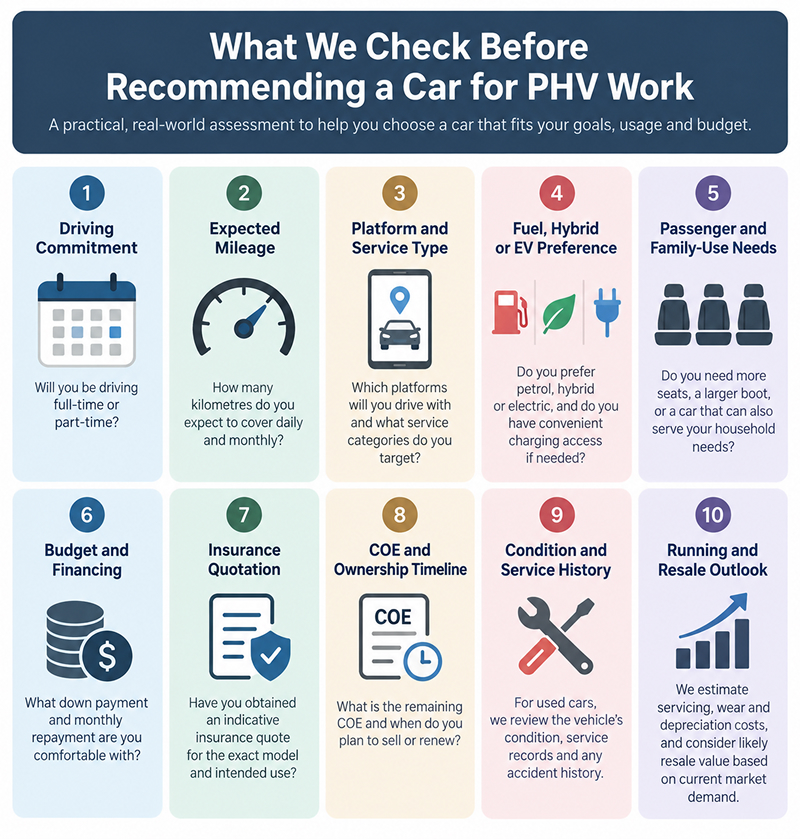
What We Check Before Recommending a Car for PHV Work
Before we suggest a car, we would want to know:
- whether you will drive full-time or part-time;
- your expected daily and monthly mileage;
- preferred platforms and service categories;
- fuel, hybrid or EV preference;
- passenger and family-use needs;
- comfortable down payment and monthly repayment;
- the insurance quotation for the exact model;
- remaining COE and intended exit year;
- service history and condition if buying used; and
- expected servicing, wear and resale costs.
These points help us shortlist PHV cars around real use rather than purchase price alone.
Frequently Asked Questions
Is PHV ownership always cheaper than renting?
No. A private hire vehicle may work out better for some long-term, high-mileage drivers, but owners also carry financing, insurance, maintenance, depreciation, repair and resale risk. Renting can remain more appropriate when flexibility and low upfront commitment matter more.
Can I convert my personal car for paid ride-hailing work?
Potentially, subject to the applicable driver, vehicle, registration, inspection, decal, insurance and platform requirements. A PHV car should not be used commercially on the assumption that its existing personal-use arrangements are automatically sufficient.
Do I need different insurance for PHV work?
Your insurer needs to know the vehicle will be used for chauffeured paid services, and the cover must suit that use. Confirm the policy scope and excess before you start driving commercially.
Is a five-year COE renewal better for a PHV?
Not automatically. The lower upfront PQP must be weighed against the car’s age, condition, expected repairs, inspection requirements and how long you plan to continue driving.
What type of car is suitable for a first-time driver?
Start with operating cost, comfort, ease of driving, servicing support and platform eligibility. A familiar, efficient car is often easier to manage than selecting a larger model purely for access to higher-capacity bookings.
Can I use my private hire vehicle for personal trips?
Yes. A car registered for private hire use can generally also be used for personal journeys. However, make sure your insurance covers both commercial and personal use, and remember that mileage from personal driving will still contribute to fuel, maintenance, tyre wear, and depreciation costs.
What should I consider when financing a car for PHV use?
Look beyond the monthly instalment. Consider how the loan tenure fits the remaining COE, the total borrowing cost, your expected monthly driving income, and whether you will still have enough cash set aside for insurance, servicing, repairs, and periods of downtime. We recommend a repayment structure that stays manageable even during slower months, rather than relying on consistently high driving hours.
Plan Ownership Around Your Driving Horizon
Owning a private hire vehicle can work when your schedule is stable, the car suits your booking pattern, and the full monthly cost leaves enough room for rest days, maintenance and unexpected expenses. It becomes harder to justify when the budget only works if the car is earning almost every day.
At M Motors, we treat the purchase as part of a wider working plan, not a search for the cheapest listing or lowest instalment. If you are comparing car options for PHV use, contact us, and we can help you assess suitable models, COE balance, financing considerations and ownership trade-offs.