Why We Tell Buyers Not to Start With the Odometer
When buyers ask us how to choose a second hand car, mileage is usually one of the first things they mention. It is easy to compare and appears to answer a difficult question: has this car had an easy or a hard life?
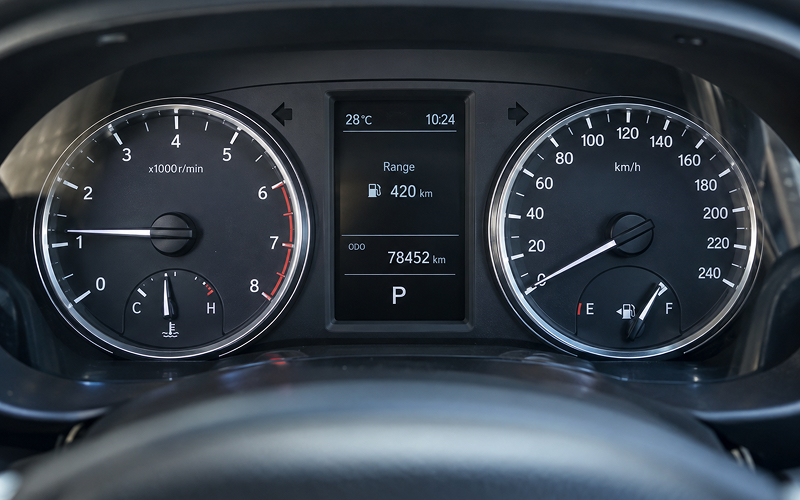
The problem is that an odometer records distance, not the circumstances behind it. It does not tell us whether the car made mostly short trips, sat unused, was serviced consistently, or has major wear items approaching replacement.
That matters in Singapore. Local cars can spend much of their time on short commutes, school runs, peak-hour traffic, and repeated low-speed journeys.
For us, context matters when choosing a second-hand car. A 50,000 km car is not automatically preferable to an 80,000 km car. We first want to understand what those kilometres represent.
Key Takeaways
- When learning how to choose a second-hand car, mileage is a useful indicator. However, it should not be treated as a verdict on condition.
- Short trips, repeated braking, idling, heat, humidity, and long periods of inactivity can create wear that mileage alone does not show.
- Service history, previous usage, physical condition, upcoming maintenance, and COE runway often tell us more about likely ownership costs.
- A low-mileage car can still need age-related repairs, while a higher-mileage car with consistent servicing may have a much clearer ownership history.
- We recommend comparing several signals in a resale car listing together instead of trying to find a single “safe” mileage threshold.
What Mileage Can and Cannot Tell You
| Factor | What Mileage May Suggest | What We Would Check Instead |
| Overall usage | How far the car has travelled | Whether the mileage came from expressway driving, short trips, PHV use, or irregular use |
| Mechanical wear | Higher mileage may mean more component use | Service records, suspension condition, brake wear, transmission behaviour, and engine performance |
| Age-related deterioration | Very little | Tyres, battery, seals, hoses, fluids, and other time-sensitive components |
| Maintenance quality | Nothing on its own | Servicing intervals, workshop records, replacement history, and recurring repairs |
| Interior condition | Limited indication | Seat, steering wheel, switchgear, trim, and cabin wear relative to the stated usage |
| Future ownership cost | Very little | Upcoming servicing, wear-item replacement, inspection requirements, and remaining COE value |
| Overall value | Only one part of the picture | Price, condition, maintenance history, COE runway, and how long you plan to keep the car |
Why Low Mileage Can Be Misleading
Lower mileage can be a positive sign, particularly when it comes with good maintenance. We simply would not use it as proof that a car is automatically better.
Short Trips Can Still Create Wear
Consider two cars of the same age.
One has travelled 45,000 km, mainly through short neighbourhood trips, school runs, and peak-hour commutes. The other has travelled 75,000 km, much of it on longer and steadier expressway journeys.
It would be too simplistic to assume the first car is in better condition. Different car usage patterns in Singapore create different stress. Frequent acceleration and braking affect brakes and tyres, while repeated low-speed manoeuvring works the steering and suspension.
That is why choosing a second-hand car means looking at the type of mileage, not just the total. A lightly driven vehicle on paper may still have experienced substantial wear and tear from city driving.
A Parked Car Is Still Ageing
Mileage also says nothing about time.
A seven-year-old low-mileage car is still seven years old. Tyres, batteries, seals, hoses, fluids, and other components can deteriorate with age.
Long idle periods may also leave you with a weak battery, aged tyres, sticking brakes, hardened rubber, or overdue fluids. These are some of the low mileage car risks we ask buyers to consider.
Low mileage shouldn’t rule out an inspection or questions.
Higher Mileage Is Not Automatically a Red Flag
When choosing a second hand car, we also avoid rejecting a vehicle solely because its mileage looks high.
A car with a predictable daily route and consistent servicing may have a clearer history than a low-mileage vehicle with sparse records.
Higher mileage is not necessarily better. It simply becomes meaningful once we understand the story behind it.
What To Look at Instead
When customers compare our pre-owned cars, we encourage them to assess several factors together. That gives us a better basis for judging a used vehicle than simply setting an arbitrary mileage ceiling.
1. Service History and Maintenance Discipline
For us, service history is one of the most useful pieces of evidence when choosing a second hand car.
We want to see sensible service intervals and prompt repairs. Workshop records can also show when tyres, brakes, batteries, fluids, belts, or suspension parts were replaced.
We also look for consistency. Does the mileage progress logically between services? Are there unexplained gaps or sudden changes in use?
These observations don’t prove a problem, but they show where to ask more questions. Low mileage cannot make up for poor maintenance.
2. Physical Condition and Wear Patterns
The car’s condition should match the story its mileage tells.
When choosing a second-hand car, we pay attention to tyres, brake feel, steering response, suspension noises, warning lights, fluid leaks, air-conditioning performance, and overall cabin wear.
Interior condition needs context too. A family car may show more scuffs without being mechanically poor, while a commercially used vehicle may show heavier cabin wear.
We look for consistency rather than cosmetic perfection. Unusually heavy wear on a supposedly lightly used car deserves closer investigation.
3. Previous Usage Profile
One of the most useful questions when choosing a second hand car is simple: what was this vehicle used for?
A private car and a private-hire vehicle can have very different working lives. PHV use may involve long hours, passenger loading, and repeated stop-start driving. That does not automatically make a former PHV unsuitable, but it changes how we interpret wear.
The same applies to family, commuter, and weekend cars. One may make many short journeys, another may follow a predictable route, while a weekend car may spend long periods parked.
Mileage becomes meaningful once we know the pattern behind it.
Why COE Runway Changes the Conversation
In Singapore, we cannot evaluate a used car as though mileage exists separately from its age and COE.
A lower-mileage car with little COE remaining isn’t always the better choice over a higher-mileage car with a longer ownership runway. The better fit depends on the car’s price, condition, expected depreciation, upcoming repairs, and how long you plan to keep it.
That is why the remaining COE value belongs in the same conversation as mileage.
Eligible vehicles deregistered before COE expiry may receive a pro-rated COE rebate. PARF rebates are separate and depend on factors including age and eligibility.
When choosing a second hand car, we ask how long you realistically want to own it. Eighteen months of COE remaining creates a very different decision from six years, regardless of similar mileage.
Look at the Costs Coming Next
Another common mistake when choosing a second-hand car is focusing so much on mileage that you overlook immediate ownership costs.
A 40,000 km car might soon need tyres, a battery, brake work, and a major service. A 70,000 km car may have had those items replaced recently.
The second vehicle can sometimes be the more predictable purchase.
Before you buy a second-hand car, we suggest listing what may be due over the next year:
- tyres and wheel alignment;
- brake pads, discs, and brake fluid;
- battery replacement;
- scheduled oils and fluids;
- transmission servicing where applicable;
- suspension or steering wear;
- air-conditioning repairs or servicing;
- manufacturer-scheduled maintenance;
- road tax, insurance, and inspection requirements.
For private cars, LTA’s current inspection schedule requires inspections every two years from age three to ten and annually after ten years.
That inspection matters for roadworthiness, but we would still assess broader mechanical condition and likely ownership costs.
How We Put Mileage Back Into Context
We do not ignore mileage. We put it in context.
When choosing a second hand car, we find five comparisons especially useful.
Compare Mileage With Age
Divide total mileage by the vehicle’s age to get a rough annual figure. Do not treat the result as a pass-fail threshold. Use it to identify unusually light or heavy use, then ask why.
Compare Mileage With Service Records
The service history should broadly make sense against odometer progression. When choosing a second hand car, steady mileage and regular maintenance usually give us more useful evidence than a low number with little documentation.
Compare Mileage With Physical Wear
Check whether the tyres, steering wheel, seats, switches, brakes, suspension, and general mechanical condition appear consistent with the stated use. Cosmetic clues are not a substitute for mechanical checks, but inconsistencies deserve questions.
Compare Mileage With Usage Type
Ask whether the vehicle was privately driven, used by a family, used commercially, shared by several drivers, or kept mainly for weekends.
When choosing a second hand car, this helps us distinguish between “high mileage” and “hard use”. They are not always the same thing.
Compare Mileage With Your Plans
The best purchase is the car whose condition, likely costs, COE runway, and price make sense for your intended ownership period.
A two-year occasional-use buyer may prioritise differently from a family planning six years of daily use.
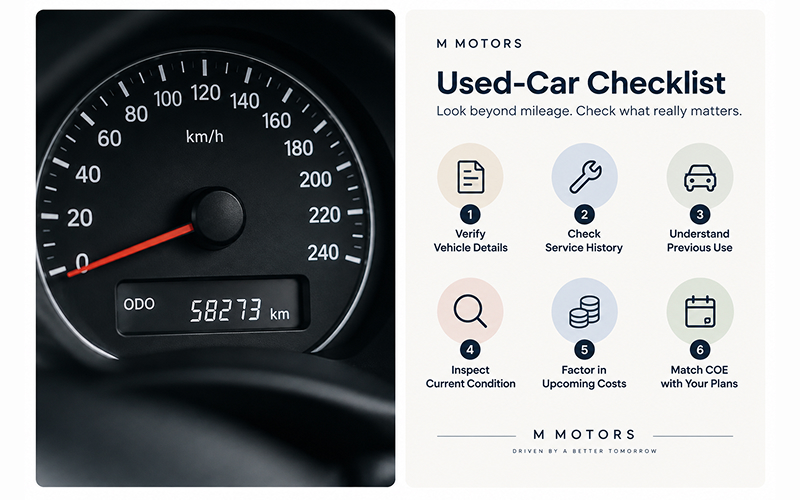
Our Practical Used-Car Checklist
If you are choosing a second-hand car from used car Singapore dealers or browsing a resale selection, we suggest working through this order:
- Confirm the registration details. Check the car’s age, COE expiry, and relevant ownership information.
- Review the service history. Look for regular maintenance, major replacements, recurring faults, and unexplained gaps.
- Understand previous use. Ask how often the car was driven and whether it had private, family, commercial, or PHV use.
- Inspect its present condition. Check tyres, brakes, steering, suspension, warning lights, air-conditioning, and visible signs of wear.
- Estimate upcoming costs. Several wear items coming due at once can quickly change the value equation.
- Match the COE horizon to your plans. Think about how long you expect to keep the vehicle.
- Then compare mileage. Use the odometer as supporting evidence, not the final verdict.
This is the framework we prefer when choosing a second-hand car because it forces you to interpret the number on the dashboard alongside the factors that actually shape ownership.
Who Should Be More Cautious About Buying Used?
Choosing a second-hand car suits buyers who are comfortable comparing condition, maintenance, price, and the remaining ownership period.
It may be less suitable if you want minimal involvement in maintenance or place a high value on having a newer vehicle.
Neither route is universally better. As a car dealer, we help you understand what you are paying for and where the trade-offs sit.
Frequently Asked Questions
Does low mileage always mean a second-hand car is better?
No. Low mileage can be attractive when choosing a second-hand car, but age, maintenance, long idle periods, usage history, and current condition can matter more than the odometer alone.
Are high-mileage second-hand cars risky in Singapore?
Not automatically. A regularly driven, consistently serviced car can be a sounder purchase than a lower-mileage vehicle with poor maintenance or unexplained history.
What mileage is too high for a second-hand car?
There is no universal cut-off. We compare mileage with age, servicing, previous use, condition, upcoming repairs, and remaining COE before judging suitability.
Is a low-mileage older car worth buying?
It can be, but inspect age-related items carefully. Tyres, batteries, rubber components, fluids, brakes, and electronics may deteriorate even when the car is seldom driven.
What should I check first when buying a used car?
Start with vehicle records, service history, previous usage, current mechanical condition, and COE expiry. Mileage becomes more meaningful once you understand those checks.
The Number Matters, but the Story Matters More
If there is one thing we want buyers to remember about choosing a second-hand car, it is that the odometer is evidence, not a verdict.
A low figure can belong to a maintained weekend car or a neglected vehicle left idle. A higher figure can belong to a hard-worked car or a well-maintained commuter. The dashboard cannot tell you which.
The better approach is to connect mileage with age, records, usage, physical condition, upcoming expenses, COE runway, and your own plans. That is how to choose a second-hand car based on likely ownership experience rather than one attractive number.
At M Motors, we help buyers compare those trade-offs instead of pushing a simplistic mileage rule. Contact us if you are choosing a second-hand car and want a second opinion on whether the history, condition, price, and remaining ownership period make sense.