Why Families Struggle With the MPV vs SUV Decision
When families come to us looking for a seven-seater, the search often begins with a simple assumption: seven seats means enough space.
In practice, that is rarely the whole story.
An MPV 7-seater car and a seven-seat SUV can both carry seven people on paper, yet feel very different once you add child seats, grandparents, school bags, a pram, and groceries. We ask who will sit where, how often you’ll use the third row, what you carry, and where you drive most.
In Singapore, daily family commuting often means short journeys, repeated pick-ups, tight multi-storey carparks, and frequent loading. A layout that seems fine on a short test drive can become frustrating when repeated several times a day.
As a car dealer, we help you work out which seven-seater removes the most friction from your actual routine.
Model disclaimer: Vehicle models mentioned are illustrative examples only and do not constitute a recommendation of a particular make, model, or variant. Availability, seating configuration, dimensions, safety equipment, powertrain, pricing, and other specifications can differ by model year and variant. Always verify the specifications and condition of the exact vehicle before purchase.
Key Takeaways
- Choosing between a 7 Seater MPV and an SUV starts with how often you actually use all seven seats. If the third row is occupied several times a week, a 7-seater MPV car often gives families easier access and more usable passenger space.
- A 7-seat SUV can make more sense when the third row is mainly for occasional passengers, and you prefer a higher driving position or SUV styling.
- We tell families to test the car around their real routine: child seats, grandparents, prams, school bags, groceries, and the parking spaces they use most.
- In Singapore, ownership cost matters as much as cabin layout. COE, depreciation, insurance, road tax, fuel or charging costs, and intended ownership period should be considered together.
- Model names are useful anchors, but the best choice depends on the exact year, variant, seating configuration, and condition of the vehicle.
First, We Ask How Often You Really Use Seven Seats
If you regularly carry six or seven people, we tend to look more closely at an MPV 7-seater car. MPVs are generally designed around cabin efficiency, so the third row is more likely to feel like part of the main passenger compartment rather than an occasional extra.
The Toyota Alphard and Toyota Vellfire are useful examples because they prioritise passenger movement, rear-seat access, and comfort. The Xpeng X9 is another modern reference point for a seven-seat MPV built around family use.
If four or five people travel regularly and the extra seats are occasional, an SUV may be enough. The Hyundai Santa Fe, Kia Sorento, and Volvo XC90 provide useful three-row SUV reference points.
We want to know whether seven seats are a daily requirement or an occasional reserve.
Why an MPV Often Wins on Access
For households with young children, elderly parents, or passengers who get in and out frequently, access is often where a 7-seater MPV begins to justify itself.
Sliding rear doors can be useful in narrow parking spaces because they need less side clearance than conventional hinged doors. That matters when helping a child or older passenger in and out.
A lower or flatter step-in can also reduce effort for passengers with limited mobility. We encourage families to bring the people who will actually use the car to the viewing.
The Honda Odyssey is a useful anchor for the classic lower-slung MPV layout, while an Alphard or Vellfire represents the taller luxury-MPV format. Both show how an MPV 7-seater car can be shaped around passenger movement.
For a family choosing a school run vehicle, we also look at whether children can enter and exit without constant seat rearranging.
Why a 7-Seat SUV Can Still Be the Better Fit
We do not automatically recommend an MPV 7-seater car to every family.
Some drivers prefer sitting higher, while SUV styling may also be a priority. If most journeys involve four or five occupants and the third row is only occasional, that compromise can be entirely reasonable.
The Hyundai Santa Fe, Kia Sorento, and Volvo XC90 are useful reference points for three-row SUVs that balance family utility with an SUV format.
What we caution against is assuming that a physically large SUV automatically gives you more usable room. Exterior bulk, wheel arches, suspension packaging, and a higher cargo floor can all consume space. When comparing an SUV with a 7-seater MPV, we care more about usable cabin dimensions than visual size.
We Test the Third Row as a Seat, Not a Specification
One of the most common mistakes we see is treating “7-seater” as a yes-or-no feature.
We recommend physically sitting in the third row. Check knee room, foot space, headroom, ventilation, and how easily you can get out, with the second row positioned where your family would genuinely keep it.
This is where multi-passenger comfort matters more than headline capacity. A third row that works for a child on a short trip may not work for an adult.
An MPV 7-seater car often has an advantage because the cabin has been planned around multiple passenger rows from the outset. In an SUV, results vary more by model, so we judge the actual car rather than the badge.
Child Seats Can Completely Change the Layout
Families with younger children should never assess a seven-seater using empty seats alone.
A child seat can change how far a second-row seat slides, whether it folds, and whether someone can reach the third row. Two child seats make this even more important.
A child below 1.35 m travelling in a motor vehicle must be properly secured with an approved child restraint. That makes restraint placement a practical and safety consideration, not merely a convenience issue.
When we assess an MPV 7-seater car for a young family, we check where the ISOFIX points are, how the second-row seats move with restraints installed, and whether adults can still reach the rear seats. Buyers should still verify the anchorage arrangement for the exact model and variant.
This is where family-friendly car design becomes tangible: clever seat mechanisms must still work with the equipment your family carries.
Boot Space Matters Most With All Seven Seats Up
Another question we ask is simple: what needs to fit in the boot when every seat is occupied?
Many seven-seaters quote generous cargo capacity with the third row folded, but that figure is less useful if you travel with all seats raised.
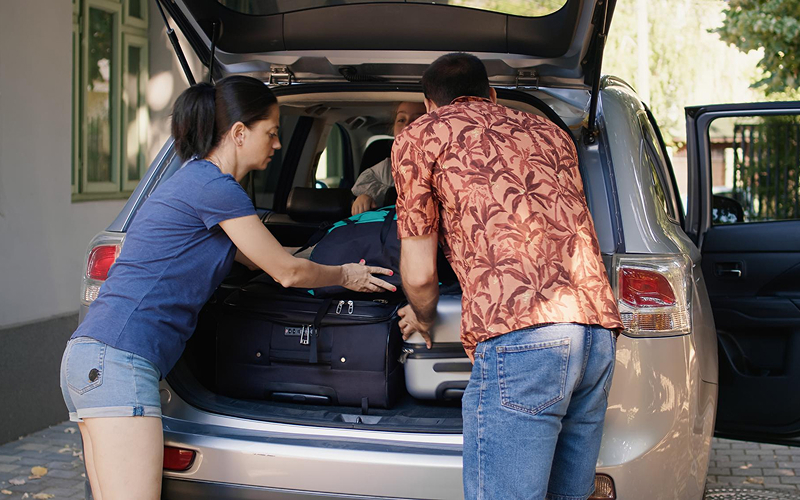
An MPV 7-seater car may benefit from a lower cargo floor or more efficient rear packaging, although this varies by model. We recommend testing what you actually carry, such as a stroller, wheelchair, suitcase, or grocery crate.
In our experience, this simple loading test can quickly change a family’s shortlist. A vehicle may have enough passenger seats, but that does not necessarily mean it has enough usable space for seven people’s belongings at the same time.
Singapore Carparks Should Be Part of Your Test Drive
An MPV 7-seater car can be spacious inside, but external dimensions still matter.
We ask families to consider their home carpark, school pick-up points, and usual malls. Length, width, turning circle, cameras, and door design all affect daily confidence.
Sliding doors can help once parked, but a long body may still need more care on ramps or in shorter lots. Large SUV doors can also be awkward beside pillars or neighbouring cars. This is why we prefer a realistic test drive over a showroom-only impression.
If you regularly park in an older multi-storey car park or have a tight residential lot, we would put this higher on the priority list than features you might only use occasionally. A family car should be easy to live with on an ordinary weekday, not just impressive during the first viewing.
We Compare Ownership Cost, Not Just Purchase Price
In Singapore, an MPV 7-seater car and a seven-seat SUV can differ meaningfully in purchase price, depreciation, road tax, fuel or charging costs, insurance, servicing, and resale demand. The result depends heavily on the model, powertrain, age, and COE remaining.
LTA explains that a COE gives you the right to own and use a vehicle for 10 years, after which the vehicle must be deregistered, or its COE renewed. We recommend considering how the remaining COE fits your intended ownership period.
As a car broker in Singapore, we prefer comparing the total ownership proposition rather than the monthly instalment alone.
Our Family Checklist Before We Recommend Either One
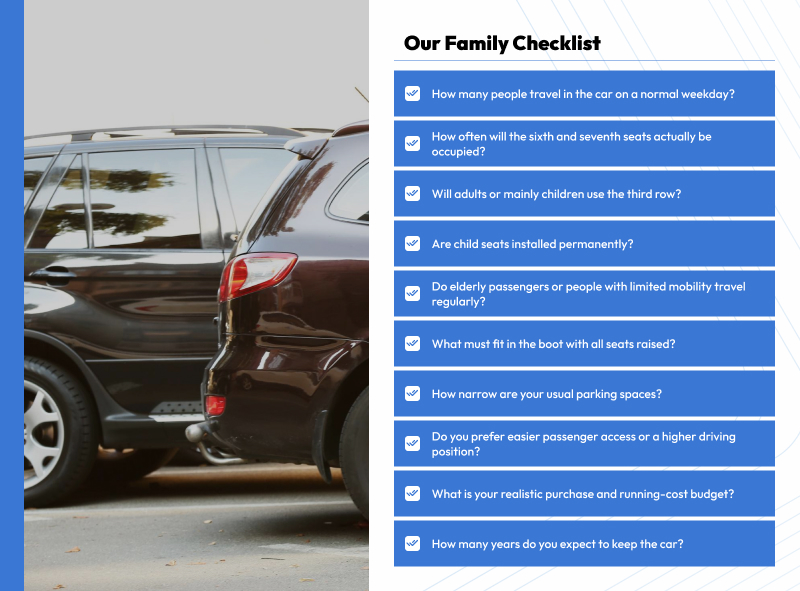
When a family asks us whether they should choose an MPV 7-seater car or an SUV, we work through these questions before recommending either an SUV or another MPV 7-seater car:
- How many people travel in the car on a normal weekday?
- How often will the sixth and seventh seats actually be occupied?
- Will adults or mainly children use the third row?
- Are child seats installed permanently?
- Do elderly passengers or people with limited mobility travel regularly?
- What must fit in the boot with all seats raised?
- How narrow are your usual parking spaces?
- Do you prefer easier passenger access or a higher driving position?
- What is your realistic purchase and running-cost budget?
- How many years do you expect to keep the car?
Browsing current car listings can also help you compare actual vehicles side by side.
Frequently Asked Questions
Is an MPV 7-seater car Always Better for a Large Family?
No. An MPV 7-seater car is often our starting point when six or seven seats are used regularly, but routine matters more than family size. A smaller household that often carries grandparents may value an MPV more than a larger family that rarely travels together.
Is an MPV Easier for Elderly Passengers?
Often, particularly where the vehicle has a lower step-in, wide openings, and sliding doors. However, MPVs vary in ride height, so we recommend having the passenger try entering and exiting the exact model.
Which Is Better If I Only Use Seven Seats on Weekends?
A seven-seat SUV may be the more balanced option if the third row is genuinely occasional and you prefer an SUV for the rest of the week. An MPV 7-seater car becomes more compelling as frequent full occupancy, easier access, and cabin movement rise in priority.
Should I Buy a New or Used Seven-Seater?
There is no single answer. When comparing options from used car dealers in Singapore, we recommend checking the remaining COE, vehicle condition, maintenance history, and depreciation alongside the lower upfront price.
We Recommend the Car That Fits the Routine
When we help families choose between an SUV and an MPV 7-seater car, we move the discussion away from which body style is “better”. The more useful question is which one makes your repeated journeys easier.
If you regularly carry six or seven people, install multiple child seats, travel with elderly relatives, or need easier access throughout the day, we are more likely to recommend starting with an MPV 7-seater car. If you use the third row occasionally and value an elevated driving position, SUV styling, or a more SUV-like driving experience, a seven-seat SUV may suit you better.
The important part is to test the vehicle as your family would actually use it. Sit in every row, install the child seat, bring the stroller, open the doors beside another car, and check the boot with all seven seats raised. These tests reveal more than a specification sheet.
At M Motors, we take a needs-first approach to car buying. Rather than steering families towards one body style or model, we look at how the vehicle fits your passenger needs, budget, ownership plans, and everyday driving habits so you can compare suitable options with greater clarity.
If you are comparing an MPV 7-seater car with a seven-seat SUV and want a second opinion based on your household, budget, and intended ownership period, contact us at M Motors.